blog

Demolition of the day: the Shard

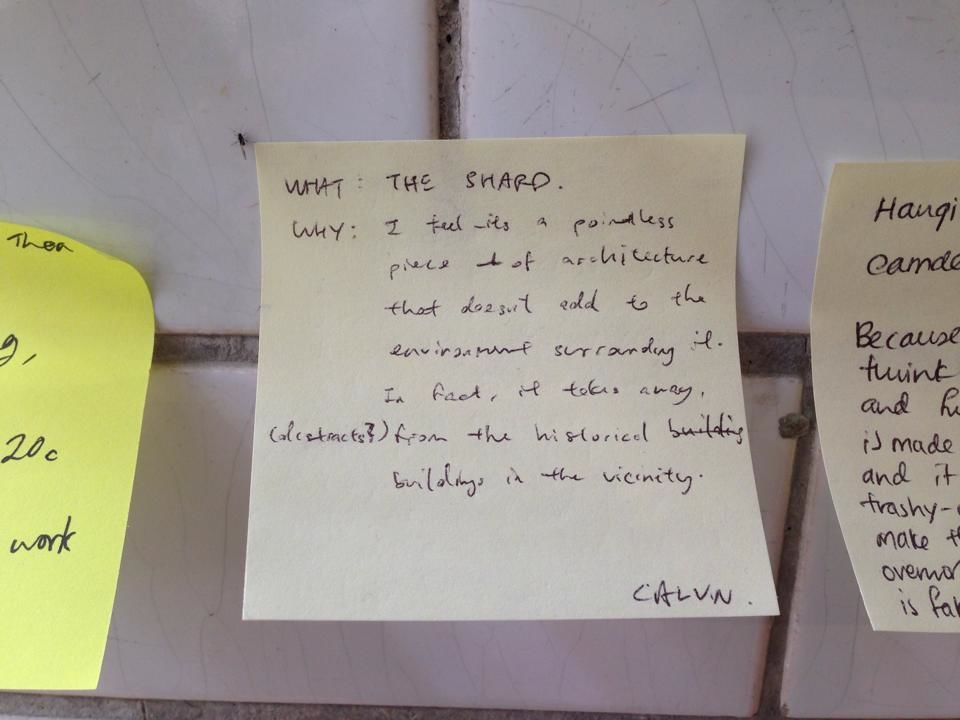
In April 2014, Calvin demolished the Shard. His reasons are as follows:

I feel its a pointless piece of architecture that doesn’t add to the environment surrounding it. In fact; it takes away, (distracts?) from the historical building buildings in the vicinity.


What will London Bridge look like without it?

Demolition of the day: Part of Hyde Park beside the Serpentine

In April 2014, Dave S dug up a patch of Hyde Park beneath a tree next to the Serpentine. This is his explanation:

Underneath a tree next to the Serpentine holds an intimate memory. Where I met one of the most important people in my life today.


Although he didn’t spell it out, we had the impression that he wanted to preserve the memory as something private, safe from the indignities of dog pee and tourist feet.

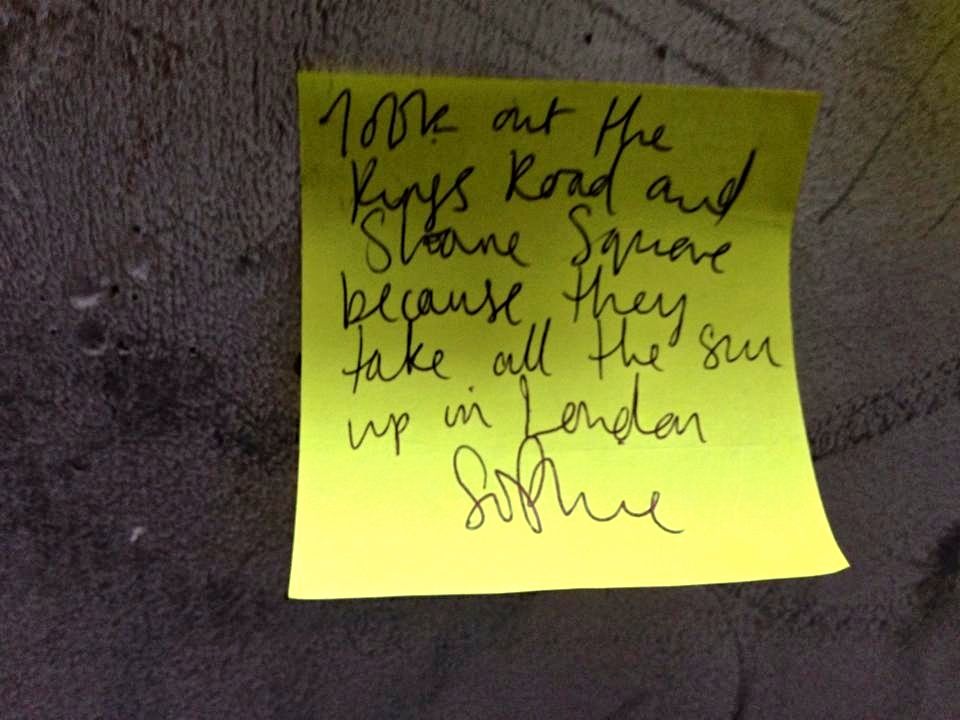
Demolition of the day: Kings Road and Sloane Square

In April 2014, Sophie demolished Kings Road and Sloane Square. She justified the destruction:

Took out the Kings Road and Sloane Square because they take all the sun up in London


So now, thanks to Sophie, the rest of the city is sunny.

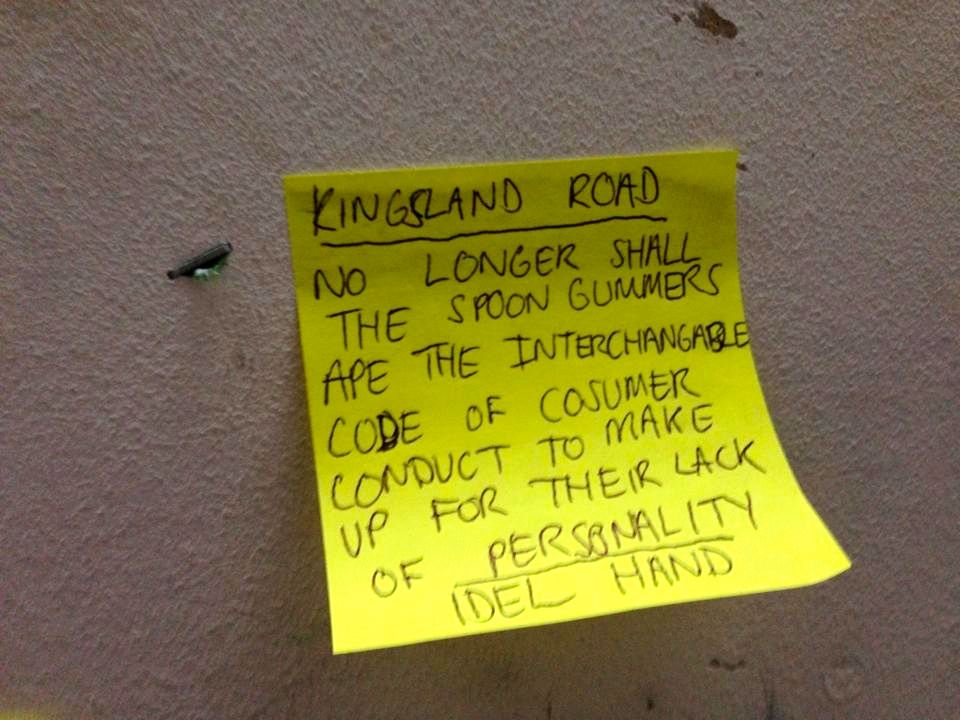
Demolition of the day: Kingsland Road

In April 2014, Idel Hand demolished Kingsland Road giving the reason:

No longer shall the spoon gummers ape the interchangable code of cosumer conduct to make up for their lack of personality


Although his spelling is idiosyncratic, I understand just what he means.

the liquid city

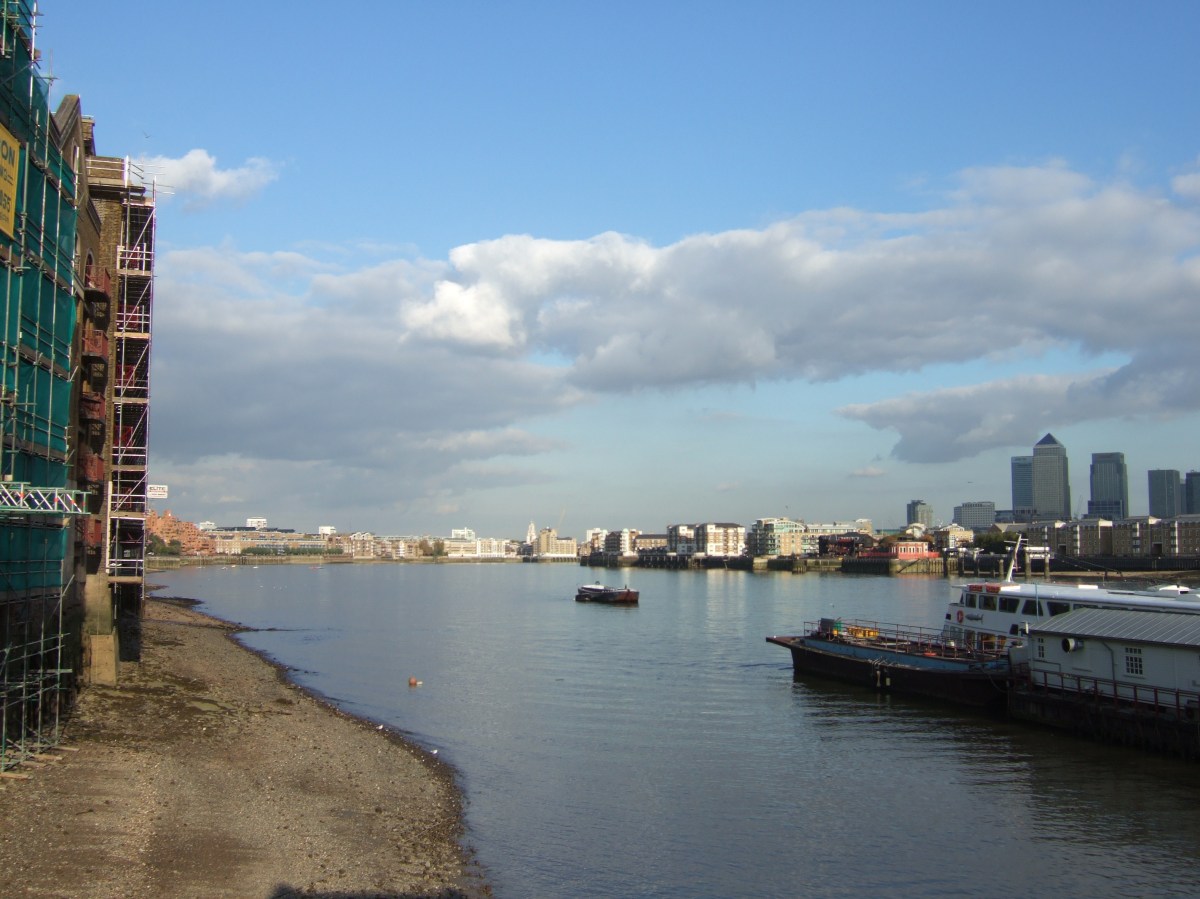
A project that proposes to re-establish an “intimate and playful link” between Londoners and the Thames raises the idea of moving through the city via its waterways.

In August 2013, one of the participants in the Demolition Project, Annalisa, decided to drain the Thames and fill it with blue Mediterranean water. Now we find that others are planning to turn the river into a swimming pool, as discussed by Ian Steadman in the New Statesman, who notes that “semi-wild swimming is a very London thing” (he cites Hampstead Heath ponds, the Serpentine and Shadwell Basin as examples).

The Thames Baths Project proposes to “re-establish an intimate and playful link between Londoners and the historic lifeblood of the city”. Led by architects Studio Octopi and landscape architects JCLA, its supporters include the Architecture Foundation (the project was submitted as a proposal in the foundation’s London As It Could Be Now: New Visions for the Thames competition) and the Outdoor Swimming Society, Jenny Landreth, who blogs about her goal to swim in all of London’s pools, and Amy Sharrocks, whose work has included walks tracing London’s ancient rivers, swimming across the city via its pools, and collecting water donations.

This slideshow requires JavaScript.

It strikes me that swimming is often overlooked as a way of exploring or relating to the city – yet all cities are patterned with watery places, from manufactured canals, pools, fountains and reservoirs, to natural rivers, lakes, estuaries and sea-coast. The Outdoor Swimming Society has a great map of wild swimming in the UK with a surprising number of sites in London, liberating swimmers from lanes, footbaths and chlorine. In central London, where the water is nasty and the currents can be fierce, it’s considered dangerous to take a dip and in 2012 the Port of London Authority banned swimming without prior permission, so it’s probably not such a good idea to try it out in the Thames just yet. Some alternatives are listed below.

A great thing about the Thames Baths Project is that its stated aim is to to restore the Thames as a genuinely accessible public space. As the project points out, it has become increasingly difficult to use the Thames as river traffic has increased, building work has blocked access to the riverside, sewage has increased and the quality of the water has declined. The Thames has a long history of being a focal point for utopian projects – from Willey Reveley’s 1796 plan to straighten it, to HR Newton’s 1861 proposal to build locks across it to halt the tidal flow – and this may be just the latest. But we can dream.

It would be nice to share experiences of liquid locomotion in the city, whether paddling in fountains or wading through the canals…

Links

• The Thames Baths Project

• Swimming in Hampstead ponds and in the Serpentine

Bring on the future: the joy (and pain) of demolitions

In 1929, the demolition of slums in an impoverished part of London known as “Little Hell” was a popular spectacle; 85 years later, a demolition of tower blocks in Glasgow will be part of the celebrations for the Commonwealth Games – but it faces a barrage of criticism. What lies behind the production of demolitions for public entertainment?

In 1929, the demolition of slums in Somers Town, an impoverished part of London behind Euston Station known as “Little Hell”, was turned into a spectacle. Huge, detailed models of the pests that infested the old housing – a cockroach, a rat, a flea and a bedbug – were made in cardboard and straw and piled up in a heap of rubble and half-demolished buildings, an audience gathered, the press were there to report on it and a retired general was brought in to set light to the pyre. The event provided a symbolic destruction of the houses and by extension the eradication of the area’s appalling living conditions, some of the worst in the capital at that time. Ben Campkin in his book Remaking London: Decline and Regeneration in Urban Culture describes it as a “physical, performative and visually impressive act”.

The old slums were replaced by bright new social housing developments by the local council and St Pancras House Improvement Society, a housing association run by middle-class activists. The publicity for the demolitions was seen as a way of heralding a new era of hope and regeneration. There is no hint in the reports of the day that the demolitions were seen as anything other than positive – no suggestion they were criticised as the actions of misguided do-gooders and money-grubbing developers, or regretted by people who had lost their homes and community.

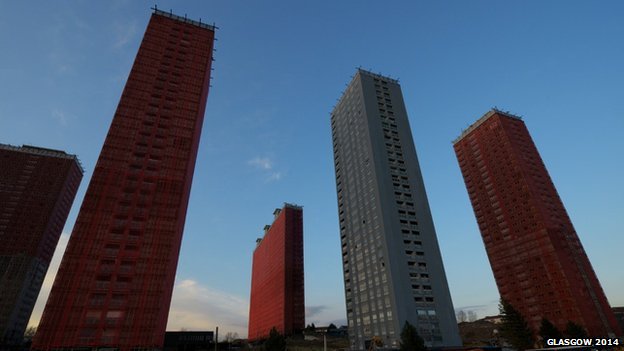
Eighty-five years later, a new demolition-spectacle is being planned by a housing association. Again, an audience is being gathered to witness the event and press will be there to document it for a wider public. Again, a notorious housing estate – this time, the Red Road towers in Glasgow (pictured above). The plan is to blow up five of the remaining six Red Road tower blocks, with film of the explosions shown live on giant screens in Celtic Park for the opening of the Commonwealth Games on 23 July.

The reasoning for the spectacle is very much the same as that of the 1929 conflagration in Somers Town.  Quoted in the Guardian, David Zolkwer, artistic director for Glasgow 2014, said: “It’s a bold and confident statement that says ‘bring on the future’.”

But this time there has been a flood of protest.

From Scottish newspaper the Herald:

While organisers said the ­demolition, the brainchild of ­creative teams within the ­organising committee, will make an “unforgettable statement” about Glasgow’s history and future, destroying buildings that were once home to thousands to provide a spectacle has been described as crass and offensive by critics.

Signatories to the petition [against the spectacle] have described the idea as vulgar, callous, arrogant and ghastly. Nicola Page, who spent her childhood in Red Road, wrote: “The world is now invited to laugh at and applaud the final death of the home that so many will mourn.”

The petition states that the demolition should instead be carried out “with dignity” and that the current plan would send out a message to asylum seekers in the one remaining tower that “they are not human enough to deserve decent housing”.

Alison Irvine, author of a novel about the Red Road estate, described the spectacle as “crude, insensitive, blunt” and accused the Glasgow 2014 committee of “trampling over the memories of people”.

Writing in the Scotsman, Joyce McMillan suggested the context of the spectacle, as part of the Commonwealth Games celebrations, “seems as uneasy and tasteless as it is bold”. She points out some other reasons for the hostile reactions:

The embrace of old and disused industrial spaces during 1990 was essentially an act of creative reinvention, and of imaginative tribute to the past; the spaces themselves were often beautiful, with a terrific melancholy grandeur, and the work created there was often breathtakingly powerful.

The demolition of Red Road, by contrast, is an act of outright destruction, and a highly ambiguous one. The flats may have been notorious … their design and construction was certainly part of the long decline of paternalistic municipal socialism, a shameful triumph of theory, ideology and influence over grass-roots democracy and common sense.

… It seems both problematic and strange to ask people to stand and cheer the destruction of such a large area of social housing at a time when the nation is in desperate need of cheap, affordable homes, and difficult to trust that the same council which built the flats in the first place, and its offshoot housing company GHA, will automatically replace the flats with something better.

It’s a view that contrasts with that of the organisers. According to Eileen Gallagher, the chair of Glasgow 2014’s ceremonies committee: “By sharing the final moments of the Red Road flats with the world, it is proving it is a city that is proud of its history but doesn’t stand still.” Gallagher describes the demolition-spectacle as a “celebration” of Glaswegians’ “tenacity, their genuine warmth, their ambitions”.

Perhaps in 1929 London, the idea of demolition as a bold celebration, of saying “Bring on the future”, held no irony and provoked no cynicism. Indeed, the estates that replaced the filthy, pest-ridden slums of Somers Town were designed by idealistic (if paternalist) architects and social workers who thought carefully about residents’ needs. Eight decades on, Britain has had more than enough experience of housing developments put up cheaply and quickly, motivated by profit, and now we are sceptical of grand statements of intent.

And maybe in 1929, there were also people resisting change, mourning the end of an era and the destruction of their homes; it’s just that they didn’t have a voice.


+++++++++

UPDATE 13 April

The demolition of the Red Road flats as a spectacle for the Commonwealth Games has been scrapped for “safety reasons” after an online petition protesting against it attracted thousands of signatures. From the Guardian:

In a statement, the Glasgow 2014 chief executive, David Grevemberg, said: “The demolition of Red Road will now not feature as part of the opening ceremony.”

Grevemberg said the decision was taken after opinions were expressed that “change the safety and security context”.

I wonder whether the sheer scale of the spectacle planned was what tipped the balance of disapproval – the Glasgow Housing Association which owned the flats had claimed 1.5bn people around the world would be watching the collapse of the 30-storey blocks on TV. Behind the display were the same good intentions that motivated the Little Hell demolitions –  Grevemberg claimed the idea was to tell “the story of Glasgow’s social history and regeneration” and the housing association said the demolition would “serve as a respectful recognition and celebration of the role the Red Road flats have played in shaping the lives of thousands of city families”. But instead of respect and celebration, the protesters spoke of the act as disrespectful, “disuniting”, ruthless and insulting; in the contest of emotions, their anger has won the day, and presumably the demolitions will go ahead out of the spotlight.


Some links

• Florence Foster talks about growing up in Little Hell in the early 20th century

• Photos on Flickr of present-day Somers Town

• The demolition of part of Red Road flats in 2012 – video

• Short history of Red Road flats 
Destroying monuments part two: smashing Lenins

There are more ways to reshape a city than demolishing, constructing and transforming buildings and infrastructure. Sometimes changes to smaller fragments of the city can have a powerful effect.

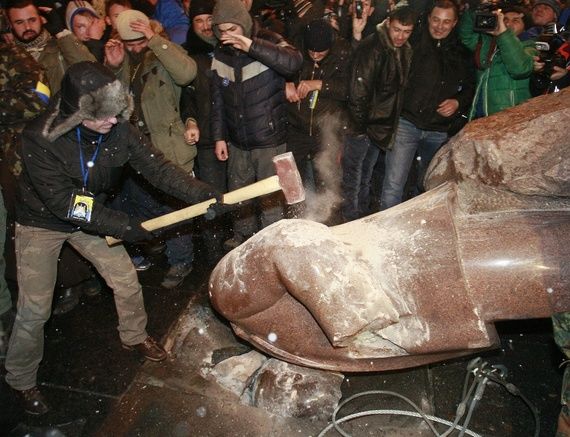
Recent events in Ukraine have highlighted monuments’ political potency, suggesting that they can be so deeply embedded in the identity of a place they become a natural focus and flashpoint when that identity is threatened with radical change. There has been coverage internationally of the destruction of statues of Lenin in Ukraine following the smashing of the monument in Independence Square in Kiev by pro-European and nationalist protesters. There are online maps showing the places where about 100 similar relics of the Soviet era have been attacked and pulled down.

Srecko Horvat, writing in the Guardian, points out that the destructions were foreshadowed by a virtual demolition in 2011, when a promotional video for Ukraine digitally erased the statue of Lenin in Liberty Square in the north-eastern city of Kharkiv, leaving only an empty plinth.

Such erasures of history happen whenever there is far-reaching political change – and the collapse of communism in eastern Europe at the end of the 20th century brought the smashing or removal of monuments on a large scale. Horvat remembers the widespread destruction of remnants of the Tito era as Yugoslavia disintegrated. “In the period from 1990 to 2000 at least 3,000 monuments were torn down in Croatia alone,” he says.

Elsewhere, Soviet-era monuments were displaced from their sites and corralled into holding pens or theme parks – which in turn have become tourist sites. Budapest has Memento Park, designed as an educational resource-cum-propaganda tool (as Hungary’s president said: “The Statue Park utilizes politically neutral means of art to emphasize the dignity of democracy and the responsibility of historical thinking.” Lithuania has Stalin’s World (officially called Grutas Park); Russia itself has Fallen Monument Park in Moscow.

In Ukraine, too, many statues from Soviet times were taken down after it became an independent state in 1991; others were replaced with ones of the country’s national hero, the poet Taras Shevchenko. But plenty remained until the latest round of regime change.

In fact Kiev’s Lenin had been a focus of conflict at least as far back as 2009, when the then president Viktor Yushchenko had called for the country to “cleanse itself” of Communist symbols. The statue was vandalised and mutilated, leading to street brawls that spotlighted the divisions in society. But it wasn’t just pro-Russian Ukrainians who rushed to its defence –  Denis Vertov made an eloquent argument for preserving the monument for the sake of art history.

With the fall of Yanukovych, Lenins in Kiev and the west of the country fell like dominoes – at one point the Lenin in Kiev’s Independence Square was replaced by a golden toilet as a satirical comment, then by an artwork made up of golden mannequins. Meanwhile in the Russian-speaking part of Ukraine, they continued to preside – the old revolutionary now standing for the status quo, nostalgia, the past or the Russian motherland. In Kharkiv, for example – once the capital of Soviet Ukraine, where Russian speakers are in the majority – crowds defended the statue of Lenin against supporters of the new government who sprayed it with graffiti, in a standoff that lasted for more than a week.

But alongside the ideological reasons, perhaps there is also truth in the reason given by Andrei Borodavka, a Kharkiv journalist and anti-Euromaidan activist: “Lenin is the place where you meet girls for a date. Or where you go after your school graduation. Newly-weds visit Lenin too. He’s in our memories.”

Does a monument come into its own only when it is taken for granted, used as a landmark or meeting point and photographed by tourists as a picturesque historic sight? The suggestion is that Kharkiv’s Lenin (and others like it) is so much a part of Kharkiv that its removal would threaten the memories and identity of its residents – it has become detached from the story of Vladimir Ilyich Lenin himself as a historical figure and melded with the fabric of the city. It’s hard to take this at face value – the political aspects of the statue’s installation and preservation are surely embedded in its meaning just as firmly as those teenage dates and school graduation photos. But equally, the everyday functions of monuments should not be forgotten; when they are destroyed, part of a citizen’s personal past is ripped away alongside the reshaping of the city’s political and social history.

Part one of this piece looked at a monument recreated with its own destruction built into the design.