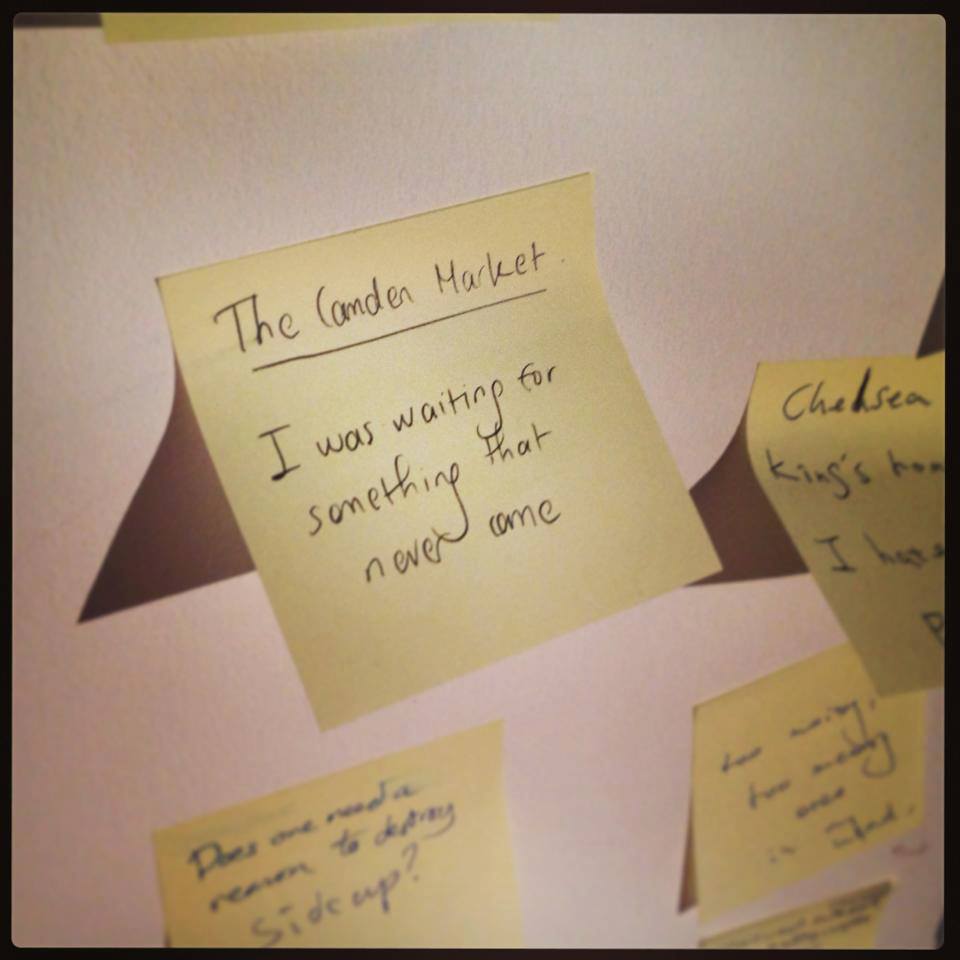
Demolition of the day: the Olympic Press Centre

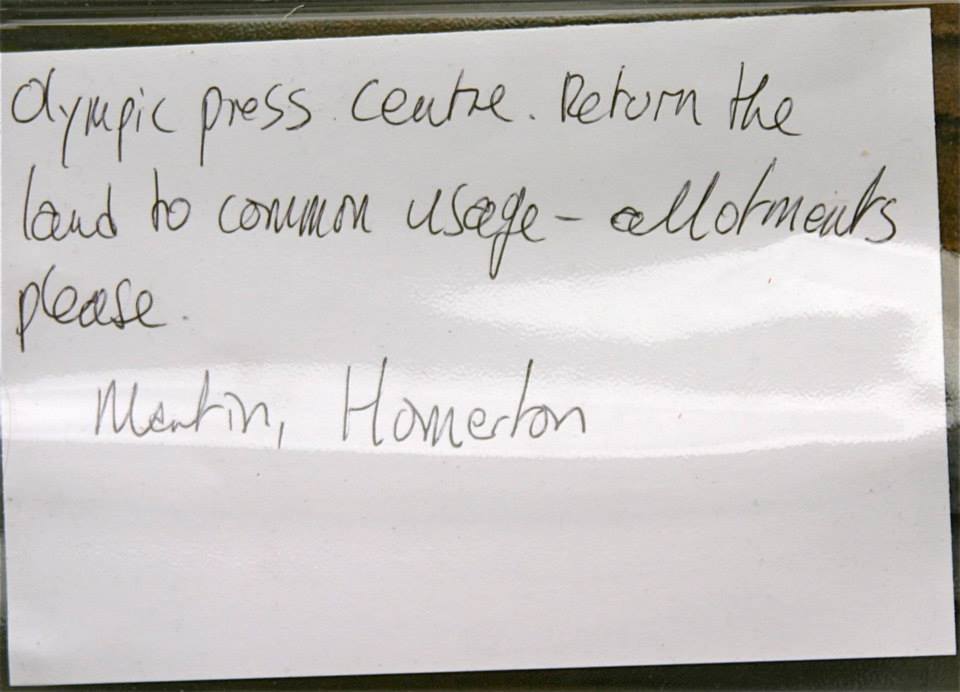
In August 2013, Martin of Homerton demolished the Olympic Press Centre in Stratford in order to:

Return the land to common usage – allotments please.

Martin’s action will go someway to restoring the Manor Garden allotments that were controversially demolised in 2007 to make way for the 2012 Olympics site.

Transformations at Tesco: a walk round Stoke-on-Trent

Exploring refrains for uncertainly sacred spaces, or a report on walking as imaginative adventure

The other day I went for a walk in Hanley, Stoke-on-Trent. It’s quite a long way to go just for a walk (about two and a half hours on the train) but there were at least two things that made it worthwhile: it was part of the events around AirSpace Gallery’s Walking Encyclopaedia exhibition which I wanted to see, and it was led by Phil Smith, artist/writer/performer and progenitor of Mythogeography, which is like psychogeography but also quite different (have a rummage in the capacious and inspiring website to find out more).

stoke abc

The walk, titled Refrains for Uncertainly Sacred Spaces, started at AirSpace, a warm and welcoming artist-run gallery whose Glen Stoker came with us on the walk armed with a video camera. The Walking Encyclopaedia exhibition, which includes Tim Knowles’ solo show, Paths of Variable Resistance, ends on 15th March but I hope it will be archived for future reference at the end rather than dispersed – it’s a dense and wide-ranging collection of documentation of “walking as a cultural practice” by contemporary artists, including artist books, leaflets, instructions, videos, photos etc. There’s also a blog to accompany it.

Before we set out, Phil introduced the walk by talking a little about his current interest in privacy and exposure, and also describing the afternoon as an experiment – so if things didn’t quite work that would also useful. There were about 20 of us – a strange and interesting mix of people, some of us shod for a cross-country hike (me) and others who knew or guessed it wouldn’t be quite so arduous. In fact, we never strayed very far from the gallery – the walk proved to be a detailed exploration of the “uncertainly sacred spaces” all around us, and a strenuous workout for the imagination rather than the leg muscles.

stoke chapel

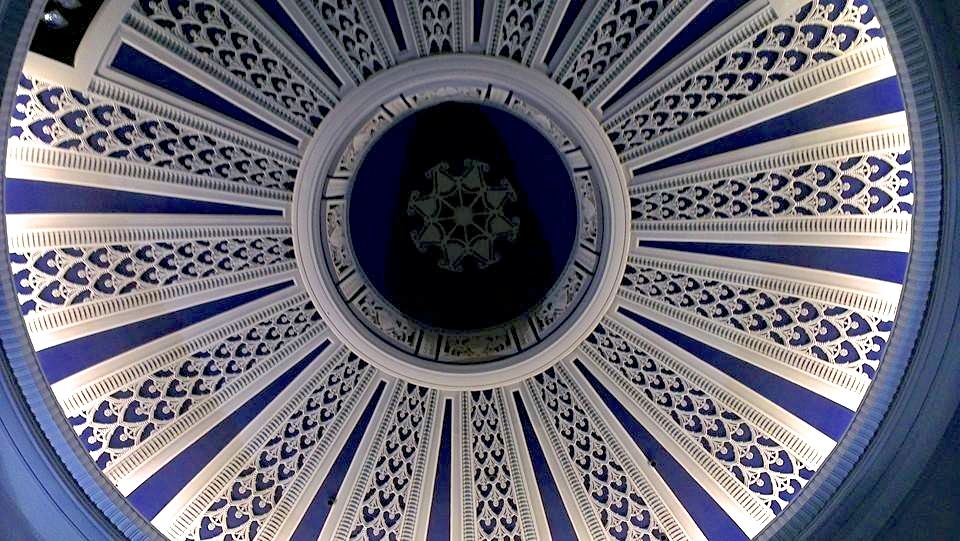
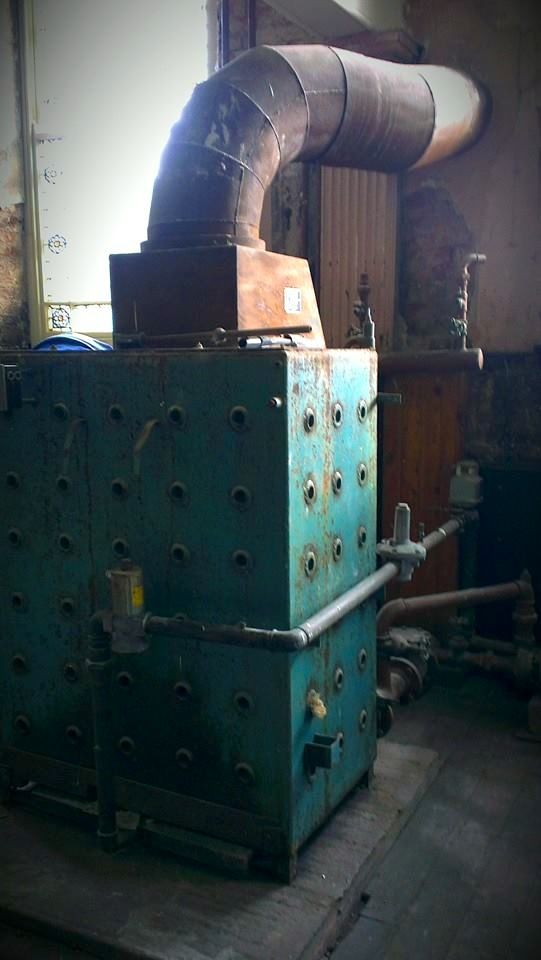
Those spaces included a patch of wasteland that was once a cinema, the arches leading to Tesco’s car park, some peculiar flower beds seemingly modelled on an altar for human sacrifice, unmonumented plinths in a former graveyard, cryptic marks on a wall, a Methodist chapel suspended in aspic-dust halfway between ruin and restoration, and the empty stage of the Regent cinema. We also walked very slowly around the Richard Long exhibition in the Potteries Museum, trying to get in touch with the spirits of the architects behind the 1960s building, and we clustered into a pedestrian horse outside the horseshoe-shaped doorway of a legal chambers. Along the way we cast health and safety to the wind, climbing over hillocks and holes and broken floors and risking arrest (or drawing attention) by quietly looking for things to steal, committing tiny acts of arson or disguising ourselves in black masks (our own personal patches of darkness)…

stoke regency1

This was walking as an imaginative adventure, full of suggestions to look harder at the urban furniture we take for granted and invitations to create fictions for ourselves, whether projecting a memory of darkness onto an imagined blank screen or stealing words from a derelict space. Some parts worked better for me than others – I was quite shocked that I felt a deep resistance to the idea of desecrating a chapel with sneak-thiefery, even if it was a symbolic rather than a real crime. On the other hand, walking round with a secret piece of darkness in my pocket was deeply appealing and the idea of later using that darkness (a small patch of cloth) as a veil of privacy had resonances I’m still pondering. Geographically, we covered a very small patch of ground but that meant we had time to explore it in detail within the various fictional frames that Phil suggested and supported with small invented (or excavated) rituals. What was on offer was a different way of seeing and relating to the everyday, a way to access something hidden beneath the skin of the banal.

stoke boilerstoke obelisk

Thoughts on walking art

I have vague feelings of discomfort around the idea of walking as art, or as a “cultural practice”. For one thing, it seems extraordinarily pretentious to anyone not involved with the art world to label as art an activity as basic and commonplace as eating or urinating. But this is also something I find exciting – it has the capacity to tread that invisible line at the border of art and the everyday, to explore that line and perhaps to blur it.

It can be participatory, pleasurable and potentially open to everyone; or private, esoteric and difficult, available to only the initiated. Or anything between these two. It can be an ongoing project that anyone can pick up and practise for themselves, or a one-off, unrepeatable event only thoroughly experienced by the artist, with the audience allowed crumbs from the table – fragments of documentation or recollection held captive in a stark white gallery far from the action. Either way, it doesn’t easily produce something that can be collected by oligarchs or sold at Sotheby’s for headline-making sums.

Perhaps the obstacle is the label – is it possible to just think of this activity as walking? What is the distinction between undertaking an “art walk” and simply using one’s feet to get around or go for a hike or take an old-school guided tour? All of these walks can have varying degrees of structure and direction. I think the artist’s walk might tend to have the intention of affecting the participant or the audience in some way, whether by involving them in an unusual activity or shifting the way they perceive and process the world. This was certainly true of Phil Smith’s walk, at least for me.

But it can be quite a subtle distinction. Ben Waddington, talking about his current festival of guided tours in Birmingham, says “The Still Walking outlook is that everything around us is worth looking at, thinking about and talking about” – which seems to make that vital connection between walking as a popular pastime and the aims of types of participatory art – does there really have to be a big gap between walking art participant and someone who takes a country walk to look at the landscape or who goes on a tour to learn about the history of a place? But of course, framing a walk as art allows you to apply for a grant or use it as research material for a PhD, which is quite another matter; it can also alienate people who would otherwise engage with and enjoy the experience.

I don’t have a clear answer at the moment. Any comments would be appreciated.

Some links

• AirSpace Gallery

• Phil Smith’s Mythogeography site

• Still Walking festival

• Walk On “From Richard Long to Janet Cardiff – 40 years of art walking”, an exhibition at Mac arts centre in Birmingham until 30 March 2014

• The Richard Long exhibition has ended at Stoke but it will come to Burton Art Gallery and Museum in Devon from October

Demolition of the day: White City flyover

In June 2013, Frances demolished White City flyover because:

Under this flyover are is a load of temporary housing. So families are having to live with billions of cars flying above their heads the whole time… So getting rid of the flyover give them a bit of peace & quiet.

Demolition of the day: Archway tower and gyratory

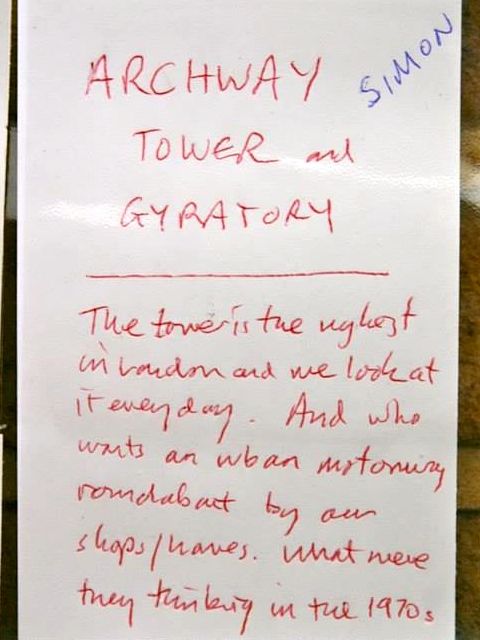
In August 2013, Simon demolished Archway Tower and Gyratory because:

The tower is the highest in London and we look at it every day. And who wants an urban motorway roundabout by our shops/homes. What were they thinking in the 1970s

Demolition of the day: Oxford Street

In October 2013, Ursula demolished Oxford Street as a shopping centre and replaced it with a giant aquarium running the entire length. She summed up her actions:

Oxford St. –> Shit.
Aquarium instead

In a longer conversation, we talked about transforming people’s lives away from consumer society to the beauty and calm of watching marine life or perhaps swimming the from Tottenham Court Road to Marble Arch.

Subsequently, I discovered that in 1954 there had been a scheme to build glass-bottomed canals and swimming pools above the pedestrianised roads of Soho, but it came to nothing until Ursula’s imaginative intervention found the right place to realise this visionary transformation, in the neighbouring shopping street.

Sounds of the city

We often talk about the city in terms of what we see – think of sightseeing, tourist sights, eyesores; architecture that frames a vista or lets in the light or blocks the view. A sound walk offers a different type of urban encounter, one that radically shifts the way we perceive the world, away from what we see and towards what we hear.

I reckon most of us (if we’re sighted) tend to think of the city in visual terms, whether we’re aware of it or not. We talk about sightseeing, tourist sights, eyesores; buildings or landmarks that look ugly or beautiful or dull; architecture that frames a vista or lets in the light or overshadows its neighbours or blocks the view of other sights we want to see. Certainly that’s true for me – it’s just that I’m so used to taking it for granted that I don’t even consider other types of urban encounter.

I recently went on a sound walk through part of south-east London, led by artist John Wynne, that radically shifted this perspective. About a dozen of us gathered in the drizzle outside Island Gardens, the misleadingly exotic name of a DLR station at the southern tip of the Isle of Dogs. We’d been told the rules: no photographing, no sound-recording, no talking (unless absolutely necessary), try to stay more or less with the rest of the group. I’m not usually a fan of lots of rules, but it would soon become clear that these were necessary to the task of cracking open our comfort zones and showing us the city as a world of sound.

The initiation

John’s tactic to move our attention from sight to sound was a simple one: the group was split into pairs, with one in each pair wearing a blindfold and being guided by the other, who wore earplugs. After a time, we swapped roles. This was just the first part of the walk – after about 10 minutes we continued without blindfolds and earplugs – but for me it was very effective. To set off walking, relying on a partner I’d never met before to keep me away from collisions and trips, was a jolt. As I settled down and started trusting him, I became more aware of the sounds around me as well as the feel of the ground beneath my feet and the wind on my face. When I exchanged blindfold for earplugs, sound was transformed from something in the world outside myself into an interior pattern of muffled vibrations in my bones. By disorienting and defamiliarising, these artificial handicaps prepared us to listen.

The ritual initiation into the city-as-soundscape took place as we walked through the foot tunnel under the Thames – a site that was interesting acoustically, with its echoes and rumbles, as well as providing an almost-too-perfect symbolic crossing-over. Not that this was spelled out – I wouldn’t want to equate south London with the afterlife, and at the time some of us were just too glad to shed our blindfolds and unplug our ears to worry about the semiotics of river crossings – but it seems typical of the way the walk as a whole was thoughtfully structured to introduce us to sound as a sensory experience and an alternative approach to exploring the city.

Listening

After we emerged on the far bank of the river, we followed John through a hugely varied progression of sounds and soundscapes, full of elements that were random and spontaneous but felt carefully orchestrated. The crunch of feet on shingle, the museum-like peace of a tourist attraction on a rainy day, chatter amplified by the high ceilings of a grand hall, snatches of music mingling with heavy machinery, a jostling market, busy traffic, lorries on an industrial estate, construction work, the gush and rush of a small waterfall beneath a railway line… And an hour and a half later we reached a cafe for the after-walk conversation out of the rain.

A couple of people talked about how the sounds of the world came to seem hyper-real, like an exaggerated soundtrack to a film they were in – which was either disturbing or enjoyable, depending on your point of view. Part of the walk, in the market, had struck some people as being like a bad film filled with stereotypical market dialogue – showing that if you listen, you can hear people genuinely talking in clichés in real life.

Some found paradoxically that their other senses were heightened – touch, smell, even vision – once they started paying attention to hearing.

One felt that we were like ghosts because we were moving through the world in complete silence. This was most obvious at one point where we all stopped in a relatively busy courtyard to listen to the sound of music rehearsals in a nearby room – passersby were clearly freaked out by the sight of a dozen people standing still, unnaturally quiet, all listening intently.

We also discussed the difference between indoor and outdoor sounds – outside, you listen to particular sounds with little or no idea where they are coming from; inside a building, you listen to the space – the way the architecture shapes the sounds.

A different angle

One thing that interested me was a double-defamiliarising that I glimpsed from time to time on the walk: not just switching my attention to sound, but a letting go of the compulsion to make meaning from it – to identify sounds as eg cars, footsteps, birdsong, wind in trees – and instead enjoying sounds as pure pattern, pitch and rhythm – as music, if you like. And we talked a little about how once we start listening to sound as music, we stop judging sounds as unpleasant, mechanistic, irritating etc – it’s all potentially interesting.

All of these ideas are interesting to explore further as a way of approaching the city from a different angle (argh, those visual metaphors are hard to escape!). And this is the sort of walk anyone can do – though it helps to take a friend, of course, if you are going to experiment with blindfold/eyes shut at the start. Although having said that, I felt lucky to have the chance to benefit from John Wynne’s expertise and his calm authority as a guide. One tip he gave us (familiar to anyone who’s done mindfulness meditation) was not to worry if our concentration flagged, but to just acknowledge that and bring our awareness gently back to listening.

There’s nothing obviously earth-shattering or agitprop about this sort of artistic activity (plenty of people would argue it isn’t art at all) but it attempts to wake us from our everyday sleepwalking through life, heighten our awareness of the world and shake us out of our habitual views and for me that makes it worth doing and worth talking about. Any views?
sound 1

>> The sound walk was co-ordinated by Tommy Ting, an associate artist at Open School East, a bunch of artists in east London who do all sorts of interesting stuff, including a lot that’s open to the public and free/cheap.

>> John Wynne’s website is full of information on his sound installations and his work with endangered indigenous languages.

In the news: tearing up the city

This is the first in a series of regular posts linking to stuff The Demolition Project has seen and liked recently.

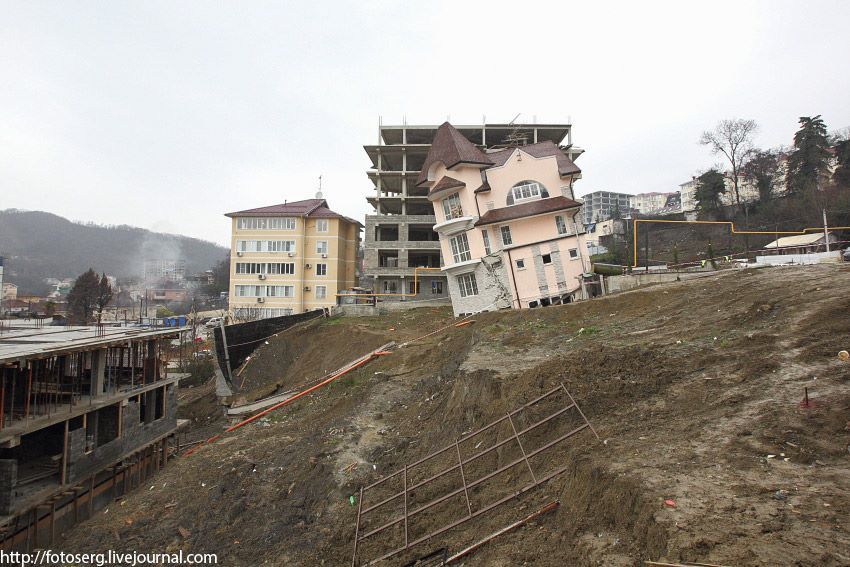
Sochi 2014 is everywhere, of course, so we kick off with a couple of stories about the way the Olympics has reshaped (or devastated) Sochi:

The residents of 5a Akatsy street have lived for years with no running water or sewage system. Construction for the 2014 Winter Games has made their lives more miserable: The new highway has cut them off from the city center. Even their communal outhouse had to be torn down because it was found to be too close to the new road and ruled an eyesore.

Full story here.

And residents talk about being relocated by the Olympic bulldozer on Youtube (English subtitles).

Elsewhere, a mayoral candidate in Paris plans to turn ghost Metro stations into swimming pools, restaurants and night clubs. The pictures look great but the scheme has failed to put centre-right UMP candidate Nathalie Kosciusko-Morizet on top of the polls.

The president of Kazakstan, Nursultan Nazarbayev, has suggested changing the name of the country to Kazak Yeli (Kazakh Country), with the suggestion that the “stan” part of the name puts off foreign investors. Full story here; some photos of the astonishing architecture of Kazakh capital Astana here and here, illustrating the country’s ambitious post-Soviet reinvention.

Lastly, a transitory intervention into the shape of the city – a machine that writes graffiti in sand.

Photograph: fotoserg/livejournal.com

Demolition of the day: 86 Orwell Court

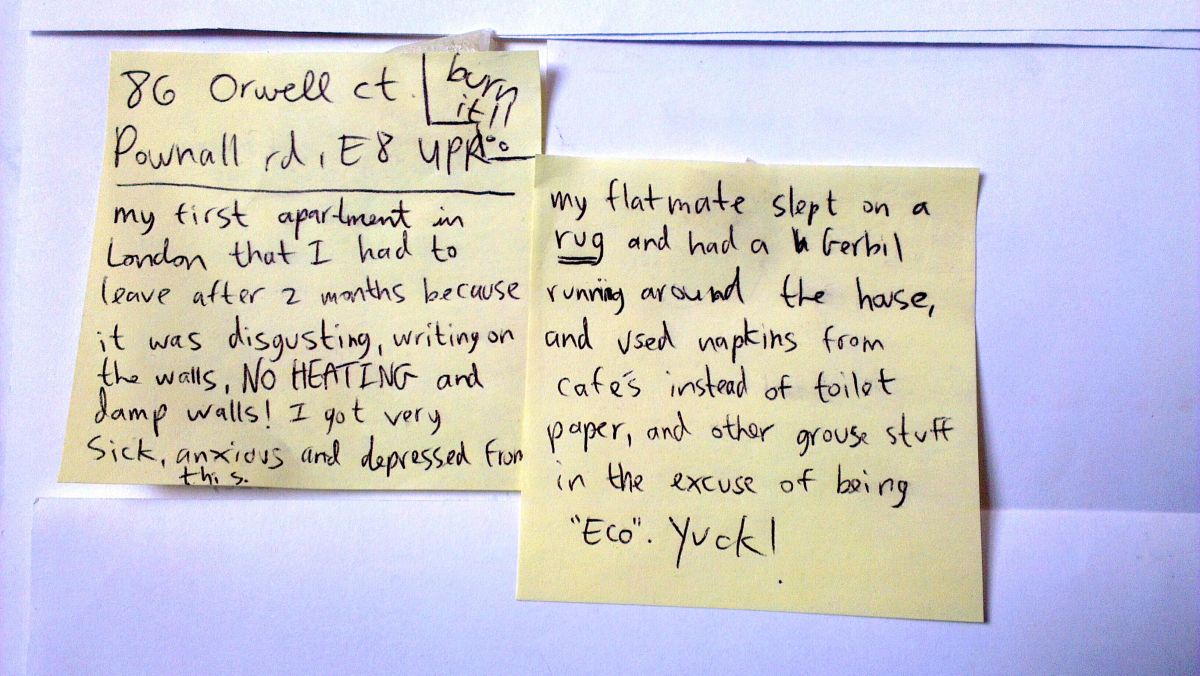
In June 2013, Anonymous burned down 86 Orwell Court, Pownall Road E8 because it was:

My first apartment in London that I had to leave after 2 months because it was disgusting, writing on the walls, NO HEATING and damp walls! I got very sick, anxious and depressed from this.

My flatmate slept on a rug and had a Gerbil running around the house, and used napkins from cafés instead of toilet paper, and other grouse stuff in the excuse of being “Eco”. Yuck!

Books and bombs: Al-Mutanabbi Street Starts Here

A street becomes a symbol of the power of words on paper; when it is destroyed, a project seeks to rebuild it in words and paper.

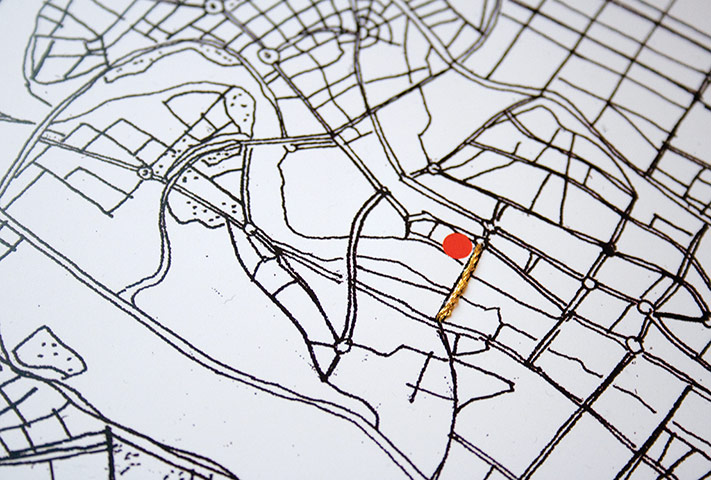
The pictures of maps here are from a book made by my friend Mona Kriegler for Al-Mutanabbi Street Starts Here, a really interesting project that makes explicit the relationship between place and the imaginative, between symbolic and physical realities.

The project began in March 2007 when an American poet, Beau Beausoleil, read about an incident in Iraq the previous day – a car bomb exploding on Al-Mutanabbi Street in Baghdad, killing 26 people and wreaking devastation. The street, named after a revered 10th-century Iraqi poet, had been home to bookshops, stationers and cafes where writers and artists gathered, and the bombing was widely seen as an attack on the country’s literary and intellectual life.

Mona Kriegler, The Autonomy of Pain

In truth, the area had started to transform in the 1990s after western sanctions started to wreak havoc on Iraqi cultural life without any need for explosive; rather than a flourishing bookshop quarter, it had become a place where impoverished intellectuals came to sell the contents of their personal libraries, spreading out their books on the street, and a rash of photocopying shops had sprouted to cater to those starved of reading matter by the dearth of imported publications. Al-Mutanabbi Street was not so much an address as a symbol of traditional art and culture. The image of a street of bookshops being blown to smithereens is a powerful one, though, and Beausoleil’s response is an equally powerful symbolic action, seeking to rebuild an area of the city in words, images and paper.

Beausoleil first asked poets and writers to contribute poems in memory of the victims of the bombing, and this became a call to letterpress artists to make broadsides – large posters, of the sort traditionally used for publishing news, ballads and proclamations – as a visual response, focused on text and typography. The next phase was a callout for book art, and between 2010 and 2012 260 artists contributed to an alternative library, which has become a touring exhibition. The third phase is a call for submissions from printmakers to contribute on the themes of absence and presence. The project as a whole already has almost 500 contributors from around the world, so it has clearly harnessed something powerful around the symbolic connections between site and art.

Attacks on culture through the actual destruction of objects, buildings and places is a common feature of conflict throughout history, of course. In a recent talk at the Mosaic Centre in London, London-based Iraqi artist Rashad Salim pointed to the burning of a library in Tripoli, Lebanon in January as just the most recent example. In the real world, Al-Mutanabbi Street was rebuilt in bricks and mortar in 2008 (before-and-after pictures here), generating conflict over whether the government was prioritising its symbolic value over the needs of other parts of Baghdad and elsewhere in the country that were destroyed in the war and/or fell into disrepair. The street’s continuing symbolic reconstruction in words and paper (an inversion of the Demolition Project) can perhaps be extended to a wish to restore all the culture that is lost in war or to iconoclastic rampage – all the vanished streets where artists once met, all the burned books, demolished libraries, smashed statues, ruined archives, ripped paintings…

krieg2

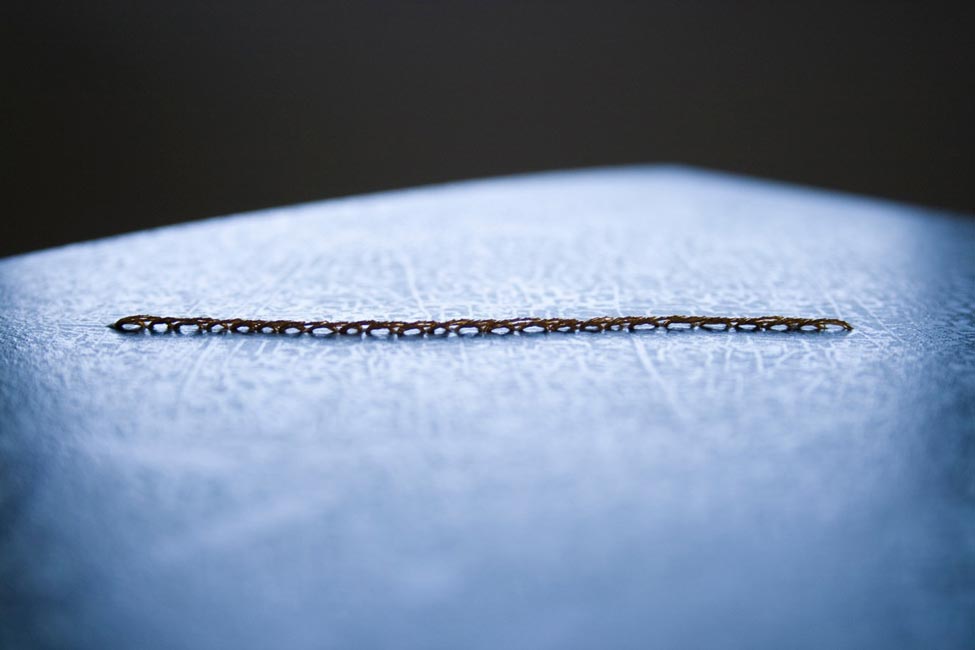
The book art contributed to Al-Mutanabbi Street Starts Here includes ingenious and beautiful work, some of it drawing on the image of the map. My friend Mona’s contribution, Pain and Memory, is one of these, using gold thread to stitch together the “scar” of Al-Mutanabbi Street on hand-drawn and aerial maps of Baghdad, an idea that draws on the Japanese wabi sabi tradition of repairing broken objects with a thin gold line along the cracks. The book is largely made up of photographic portraits of people who have been injured or broken in some way, with their scars (some of them invisible) traced in gold paint, thus drawing out relationships between the city and the body. A very different take on the aesthetics of destruction and repair, making beauty out of the tracks of repair.

Mona’s gold-stitched lines made me think about the debate between those who want to build anew and those who want to restore – similar arguments have taken place in Baghdad over Al-Mutanabbi Street and in New York over the World Trade Center site. Do we want to wipe out any sign that destruction has happened – whether by building something completely different or by constructing an exact copy of the original – or do we want to reveal and memorialise it? There is a small round plaque high up on a wall on a street near my house, commemorating the first bombing in the first Zeppelin raids in London in 1915; I walked past it a thousand times before I noticed. London is full of such small, discreet nods to damage caused in long ago wars. Beau Beausoleil’s project could prove a more enduring and constructive way to acknowledge damage through the fragile medium of paper.

Mona Kriegler, The Autonomy of Pain

More on Al-Mutanabbi Street Starts Here book art here, here and here.

A long piece on the project here.

Book photographs: Dafne Louzioti, Mona Kriegler